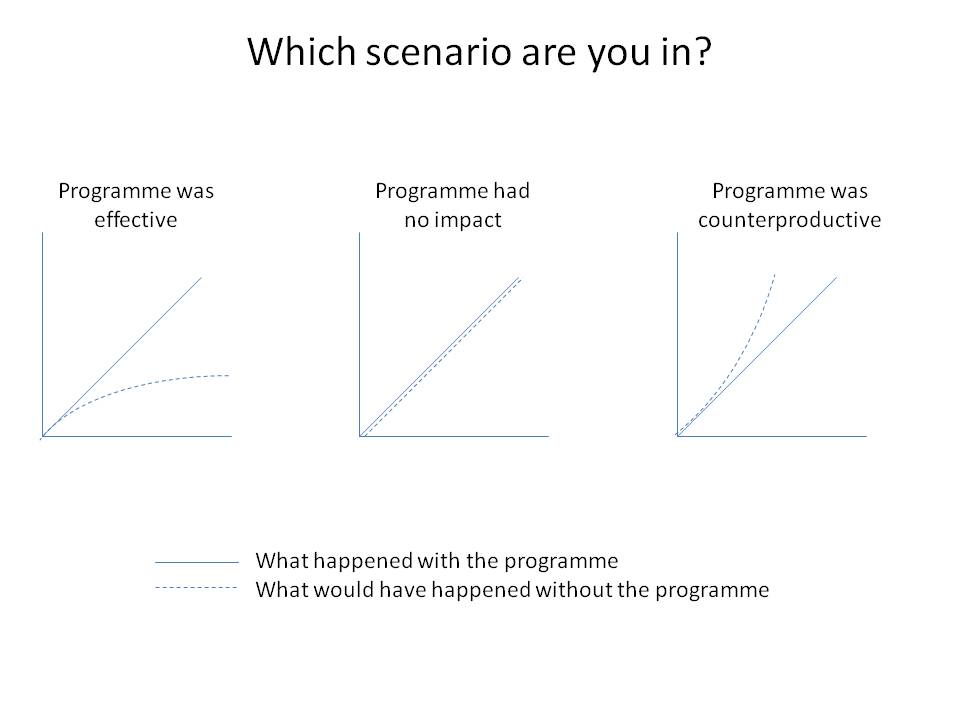
Understanding impact of a corporate giving programme

I’m currently evaluating the ‘community projects’ programme of the Guardian News & Media group (i.e., the series of ~12 partnerships which GNM has with voluntary organisations near its London HQ). In this article in the Guardian, I explain what we’re doing & why, why understanding impact is so difficult, and what I learnt about understanding impact from Albert Einstein and Ben Goldacre:

Measuring the effectiveness of the Guardian’s community projects

What else can giving learn from physics and medicine? A lot —>

Posted in Promoting giving | Tagged , , , , , , , , | 2 Comments

Forget business: philanthropy needs to learn from tons of other disciplines

Philanthrocapitalism, social return, social investment, Absolute Return for Kids… Business is the analogy most commonly used for philanthropic activity. Though that’s not wrong, it’s dangerously narrow for solving what Warren Buffett calls ‘problems which have already resisted great intellects and great money’.

Let’s think through some steps which a donor – or a charity, for that matter – might take.

Since the giant array of needs in the world creates a giant array of options for donors (and charities), intelligent donors/charities are selective. Here, a pertinent analogy is the military. Even the Romans found it hard to fend off enemies on numerous fronts, and more recently the Nazis couldn’t deal with challenges on both the Eastern- and Western Fronts. We ourselves would perhaps have done better in Afghanistan if we’d had fewer and clearer
goals. ‘A single, unambiguous aim is the keystone of successful military operations. Selection and maintenance of the aim is regarded as the master principle of war’, as is taught to all officers in the Royal Navy, Royal Air Force and British Army.

Having selected an unambiguous aim, the judicious donor (or charity) will research their starting point. How widespread is poverty? How bad are race relations? Which groups are least well served by formal education? Answering even simple ‘factual’ questions like these is surprisingly difficult, because what we see and experience is heavily influenced by what we’re expecting to see. ‘Observation is theory-laden’ as philosophers of science have found.

So the donor/ charity defines some metrics and attempts to measure the amount of poverty or race relations or whatever. Yet the act of measuring may change the very thing which is being measured: we all behave differently when we’re being watched and the researcher’s questions may focus our latent anger. Any social scientist would have foreseen that, as would any physicist: Heisenberg got a Nobel Prize for the implications of his realisation that ‘What we observe is not nature itself, but nature exposed to our method of questioning’.

To establish the starting point, the donor or charity commissions a survey which, to minimise the Heisenberg effect, sequences the questions carefully. Psychology has much to contribute: to take just one example, psychologists have found that when young people are asked how happy they are and then asked when they last went on a date, their happiness rates totally differently than if they are asked the exact same questions just in the opposite order! Lawyers could help here too, since they know about (avoiding) leading the witness.

Perhaps the donor /charity navigates all this and is eventually ready to design her ‘intervention’ to get people to do more X or less Y: to drive more safely, to commit fewer crimes, to vote less tribally. She’d do well to engage with the newish field of behaviour economics (‘nudge’). Perhaps the most effective and least laborious ‘interventions’ are simply making it easier to repay loans,  or making it socially normal, or making it somehow fun.

Work begins. After a while, the donor /charity looks for its effect. ‘We did such-and-such and then something-or-other happened’ say many donors / charities, under the mistaken impression that this somehow indicates that the something-or-other was caused by the such-and-such. Any economist or statistician, or scientist, or indeed anybody who understands the difference between causation and correlation (such people are rarer than you might suppose) would raise an eyebrow at that. You can’t claim some God-like control of the solar systems just because the sun comes up every time you eat your Weetabix.

To really understand whether the something-or-other had anything to do with the such-and-such – i.e., whether the donor/charity made any difference – we need a control experiment. A simple one involves sitting around doing nothing to see whether something-or-others happen all the time anyway. Social scientists and physical sciences teach a great deal about constructing good control experiments. (And, by the way, rather more than business does. I’ve yet to see an article in Harvard Business Review about them, though they’re discussed in Nature all the time.)

So what?

Two implications are important for donors and charities.

First, we should open our minds to learning from many disciplines – from any discipline. Donors and charities face some of the most difficult challenges on Earth, and hence need all the wisdom and insight they can get. The observed over-reliance on one discipline is patently insufficient. People involved in these challenges should read and listen widely, for relevant learning lurks in surprising places.

And second, donors and charities should hire staff from a broader pool. Foundations are often particularly narrow, staffed entirely by people with business backgrounds, and perhaps a few aid-wonks. If you have three business people, then you have enough: your next hire should have studied physics or epidemiology or psychology.

A single analogy or skillset – however good – is most unlikely to bring the breakthroughs which the poor, the lonely, the underserved so badly need from us.

_________

Caroline Fiennes has a surprisingly useful degree in Physics and Philosophy.

This article draws on material in her forthcoming book, It Ain’t What You Give, It’s The Way That You Give It: Making charitable donations which get results.

________  

Why is NatWest giving away tax-payers’ money, so amazingly badly? —>

Posted in Analysing giving, Promoting giving | Tagged , , , , , , , , , , , , , , , , , , , , , | 2 Comments

Didn’t we have a lovely time the day we went to prison?

Inspiration inside

I’d have felt more at home on the moon. I mean, nothing says ‘welcome’ like a fifteen foot wall topped by razor wire. And yet, my trip to HMP Pentonville was surprisingly inspirational. 

I was there just before Christmas in relation to a project I’m doing for a corporate giving programme. Because we were there to meet various inmates who together write ‘The Voice of the Ville’, I was scared. Not that I’d be attacked or detained, but rather just of the unknown: the alien set-up, alien building, people of probably quite alien norms.

The first challenge was crossing London with neither money nor phone, for I’d been warned that they can disappear from prison receptions where visitors must leave them. No phone! My reliance on it is more of a tic than I’d realised – for the time, the map, the Twittering. My colleague and I had to arrange a rendez-vous in advance: how 1980s.

The prison reception has all the charm of an industrial loading facility, with added signs about ‘rub-down searches’.

The early-ness of our arrival causes us to be forgotten, so by the time we actually get collected, we’re late. A load of keys unlock a door. It’s shut behind us. Another door is opened, and shut behind us. And another. The doors, keys and bars are startling, despite being totally unsurprising. Society takes seriously the business of secreting the gentlemen we’re about to meet.

Though I don’t know what I expected – cells? riots? murderers? – the giant Christmas tree in the prison’s central hall wasn’t on my list. Was I really expecting some cheer-less slum-like Victorian poor house?

Four wings radiate from the baubled hall. Even the architecture here is alien.

As we’re led down one wing to the newspaper room, we’re trying to disguise our craning to glimpse into the cells we’re passing. Cells – as seen on Porridge and endless films – but these house real people, with real stories.

We arrive during ‘free flow’: the transfer window at the beginning and end of the morning and afternoon sessions when prisoners move (accompanied) around the building. It’s rather like the school bell, with added locks.

The newspaper room is rather like a sixth form common room. Maybe 10 foot square, it’s carpeted with a big table in the middle and desks bearing computers round the edge. But the alien is here too; signs on the wall prohibit printing ‘letters to family, letters to court…’

They start to arrive. Instinctively, my colleague and I stand and move to shake the hand of each man as he enters, as we would for any other meeting. You probably don’t get that too often if you’re a prisoner. There is, of course, only one question in our minds but we never ask it: I ask a prison-expert friend that evening and her answer makes me glad I hadn’t asked before.

One of them is huge. 10 foot tall with giant biceps. As he sits, all I can think is that he’s between me and the door…

They’re like grumpy teenagers – surly, rather monosyllabic, hard to get talking. But, man, when they get going, it all comes out. This – the Voice of the Ville (VoV) – is where they get to create, to express, to be heard, to be somebody. “You see yourself [i.e., your skills and work] developing. You don’t get a lot of ego boosts in here [prison] but you do here.” These guys may not have had many ego boosts in their lives.

The paper is a joint effort – and there’s not a lot of that in here either.

It’s a position of responsibility. Every prison gets a copy and since “there’s people here on suicide watch, you have to make sure you’re upbeat. You don’t wanna tip anybody over the edge.” Few writers have that responsibility.

It’s a haven. “There are violent people here” – who, it transpires, generally have low literacy, and develop their bravado and aggression as coping mechanisms. They’re not in the VoV team, by definition. So the VoV room is calmer than the rest of the prison. Selection bias even on the inside.

And it’s interesting. They read newspapers and books and get some brainfood. Reading matter is highly prized – so I make the ultimate sacrifice, giving one guy the copy of The Economist which is in my bag. (He’s  never heard of it, and thinks it’ll be full of numbers: I suggest he starts with the book reviews.)  Hard copies are all there is, because of course there’s no internet inside. That reinforces the weirdness: I start recounting a story I discovered on Twitter and then realised that several of them have been in here since before Twitter was invented(!)

Then this, from a guy who’s clearly not making his debut at Her Majesty’s pleasure: “it [VoV] has taught me to take criticism. We criticise [critique] each other’s writing all the time. It’s not so easy to take that at the beginning, but now I really welcome it – all criticism helps my writing get better.” That’s huge. Intolerance of other people’s views is what lands people in prison in the first place. Mr Justice Secretary, if you’re looking for ways to reduce reoffending – and I hope you are – programmes which teach people to give and take feedback should be high on your list. Plus it’s cheap as chips to run: it takes just two staffers and some printer cartridges.

Hats off, then, to the two ladies who run it. They evidently create a supportive, inspiring and pedagogic environment amongst their tough clientele, and bring in various external people who come here bearing article ideas and writing tips and feedback.

So, to my amazement, I too am inspired. Yet as we leave, there’s a prisoner in the corridor being shouted at, and the myriad keys and doors remind us that our new-found friends are locked away for a reason. I’m glad it was just an afternoon trip: a dark, wet, windy London street has never seemed so glorious.

More interesting that what a charity achieves is what it doesn’t achieve –>

Posted in Analysing giving | Tagged , , | Leave a comment

Kate Middleton’s charities: a curious but quite good set for a beginner

The Duchess Formerly Known as Kate Middleton announced today her first four charity affiliations. It’s a quirky set. If she’s clever, Kate (if we’re still allowed to call her that) can add a load more value to them.

The overriding precept of effective giving is using your resources to their best effect. For Kate, that means using her ability to attract attention. So the National Portrait Gallery is a weird choice since that’s hardly a ‘cause’ or an institution below the radar, and neither does it lack high-profile patrons. (Since she has a degree in History of Art, it presumably arises from long-standing personal interest.) By contrast, the choice of Action on Addiction is a very good one: addiction is a hidden and un-sexy curse, much like HIV was when Diana brought the press into see it.

One resource which could be used better is Kate’s rationale for her selection. She’s clearly pretty switched-on and has some good charity advisors around her, so it might be valuable if she explained why she chose the East Anglia’s Children’s Hospices given that there loads of children’s hospices, and why she chose The Art Room, amongst the numerous charities which work with troubled young people in schools.

The other great insight of effective donors is that charities vary massively in their effectiveness – much as companies do, as teachers do, as sports people do. But not all her quartet seem to pay much attention to results. Action on Addiction does: its annual report begins “This has been another year of great impact”, and goes on to discuss results extensively. It surely gets extra marks for providing the first funds to support a randomised clinical trial in one of its areas of work. The Art Room talks about results a bit but not very convincingly: it cites a some recent observational data, of frankly limited value, and a detailed study which is now seven years old and whose authors recognised that it had insufficient depth (for example, no control group, and the duration was too short for the charity’s effect to be clear). East Anglia’s Children’s Hospices have zero discussion of results either on its website or annual report, as far as I could see. Any donor does well to choose charities which obsess about their effectiveness, and to encourage them to understand it more rigorously – let’s hope she does that.

So, what should she do next? I’d suggest that she publishes her rationale, and pushes all ‘her’ charities to talk clearly and publicly about what they do, why they do it, which bits work and which bits don’t (if they say that everything works, we should suspect their economising on the truth).

As she gets more confident and savvy about charities, it would be just great if she shone the spotlight on important issues that routinely get ignored. Your Royal Highness, here are some ideas for your next selections. Female genital mutilation. Child soldiers. People trafficking. Even prisoners’ families who are routinely ignored, despite reducing re-offending. Corruption and transparency. Or, on a different tack, get interested in charities’ effectiveness and champion the work to test their approaches using proper randomised control trials.

The initial quartet is reasonable start, but, since she’s less than half the age of her father-in-law who’s still waiting for what Diana called “the top job”, there’s plenty of time to be radical.

Posted in Analysing giving, Celebrity giving | Tagged , , , , , , , , , , , , , , , , | 1 Comment

Giving a goat (or similar) this Christmas? Get an extra half a goat for free

Oxfam Unwrapped is a kind of gift catalogue from which you can ‘buy a goat’ or various other items as a gift. A goat costs £25: you give Oxfam £25, which it uses to provide a goat to somebody in a less developed country, and in return Oxfam gives you a card picturing a cheery-looking goat to give your friend. Jolly good.

Your £25 appears to be ring-fenced (‘restricted’ as the charity-wonks say) to buying goats. In fact it isn’t, for this good reason. Theoretically, each of the 50m adults in the UK could ‘buy a goat’ tomorrow, and it would be just crazy if Oxfam suddenly rained 50m goats onto the unsuspecting communities it serves. So, sensibly, Oxfam’s small-print says that your £25 will go to ‘either your chosen gift or something else in the same category.’ (Goats are in the ‘livestock’ category whereas ‘training a teacher’, for example, is in the ‘education’ category, amazingly enough.) ‘This kind of flexibility means that poor communities worldwide can get exactly what they need if and when their circumstances change’ Oxfam says.

You can go one better. You can remove the ‘restriction’ altogether by ticking a box at check-out which says: ‘I am happy for Oxfam to use my money to fund any part of its work.’

‘Unrestricted’ donations are almost invariably the best way to give to a charity. They allow responsiveness, allow the people who are actually receiving the money a real-time say in what they get, and can be used by the charity for what is actually needed at the time, rather than what was needed when the goat-catalogue was printed.

Charities say that they’d rather have £660,000 unrestricted than £1m restricted. That is, making the donation unrestricted – ticking that box – magically increases the usefulness of your donation by half. Half a goat for free.

This sounds like some dull technicality. But the difference on the ground is real, normally because restricted donations create complicated accounting and faffing about at headquarters, which itself costs money – eating up roughly the missing £340,000 in the example above.

Some charity ‘gift catalogues’ don’t even offer this option. The Good Gifts Catalogue, for example, says that ‘your money buys the gift described… we guarantee it’. Even if it’s no longer needed or the recipient community has enough of those items already or something else has become more urgent since the catalogue was printed? Isn’t it important to give communities – anybody – the right to some control over their life in real-time? They get that much more if they can influence decisions to respond to changing circumstances.

‘Tis the season to be flexible: always.

(Unfortunately when the FT reported this story, it got it wrong, describing the reduced restriction as ‘marketing bull’. At least it correctly represented my view about it!)

[Source: for the £660k/£1m: Garvey, B., Sutherland, L., 2006, ‘Restricted and project funding survey, nfpSynergy’, p. 7]

How do you find out whether a charity is achieving anything?–>

Posted in Analysing giving, Promoting giving | Tagged , , , , , , , , , , | Leave a comment

How should advice on charitable giving be priced?

Answer: In a way that aligns the advisor’s incentives with those of the beneficiary. But which way does that?

Along with many others, I’m often asked to advise donors about finding good charities to support and/or strategies to make their giving effective. I’m struggling to find a structure which does that.

Time and materials?

Nope. There are two problems here – which are common to any professional service paid for by time. First, it incentivises the advisor to take ages.  Hence some moves to pay lawyers on a piecemeal basis rather than hourly (why do I pay more just because you’re slow?) And second, it encourages the advisor to unnecessarily complicate their work (on the reasonable assumption that fees are deducted from the amount the donor has to give). Yes this arises even in the charitable world: I once saw an advisor claiming that managing a single, existing grant to a perfectly competently and stable organisation took him two days a week and required two foreign trips a year. Monsterous.

But there are two additional twists with charitable giving.

It’s easier (read: cheaper) to find charities in the UK than in, say, in South Sudan. So paying the advisor by time incentives the donor to support readily-findable charities. But you could easily argue that beneficiaries who are difficult to find because they’re cut-off from mainstream markets and funding are precisely where donors should focus.

Donors often achieve most by collaborating: partly because they reduce the number of programmes in existence, which reduces admin for both the donor and charities. They also therefore reduce the need for advisors. So paying advisors on a ‘time and materials’ basis disincentivises the advisors to push for collaboration (they’d put themselves out of a job). Putting that more strongly, ‘time and materials’ encourages advisors to promote fragmentation amongst donors, which is bad for beneficiaries. Furthermore, creating those partnerships can take no time at all. When I put together the one between Eurostar and the Ashden Awards, it only took about half a day, yet created substantial value for beneficiaries.

Percentage of funds managed?

Nope, because this incentives the advisor to advise against giving anything away!

Percentage of funds given away?

Nope, because this simply encourages the advisor to dish it all out at maximum speed, which doesn’t bode well for proper planning and research.

Furthermore, it disincentivises the advisor from looking at impact investing, i.e., using the capital for social & environmentally useful purposes before it is given away. And, of itself, this structure doesn’t encouraging using any other resources, e.g., time, contacts, reputation, convening power – which may amplify vastly the impact of any money given.

Success fee / performance-related pay?

Sadly this is impossible because there’s no single metric of success on which donors can judge their success. Charitable giving is fundamentally different to financial investing in that sense: the advisor can’t take 2% of the upside, because there isn’t one; they can’t take be paid based on whether the beneficiaries like the donor because they probably won’t know that the donor exists; they can’t take be paid based on whether the charities like the donor because that may be totally independent of whether the donor is really adding value.

Other models?

The only other model I can think of is a fixed fee. Say £10k to fix your philanthropy strategy, irrespective of the amount you’re giving or the complexity of fixing it. That feels bizarre. It also leaves the advisor taking all the risk (they then have the incentive to opt for easily-findable charities.)

Perhaps some econo-brainbox can think of a better structure. Do give your suggestions in comments below.

Posted in Analysing giving, Promoting giving | Tagged , , , , , , , | 10 Comments

How do you know if your charity is making any difference? Take control

Charities need to understand which parts of their activities are working and which aren’t. But to really understand the charity’s impact, we need to know not only what did happen, but what would have happened without the charity’s work.

Imagine a city with poor air quality. Suppose that a charity works there, trying to persuade inhabitants to turn off their car engines when idling at traffic lights. When the charity started work, the air was clean 10% of the time (it has some sensible definition for air cleanliness: perhaps the air has fewer than 10parts per million of particulates), whereas a end late, it was clean 20% of the time. Result! Really? Perhaps the improvement was due to the charity; but perhaps it would have happened anyway; and perhaps more improvement would have happened without the charity. (It’s not unknown for irritating campaigns to provoke people to ‘rebel’ and do the opposite of what’s being asked.)

These kinds of ‘before/after studies’ indicate precisely nothing about whether the charity is doing a good job. It’s scary because they’re very common amongst charities (and others). If you think about it, the example above is analogous to an educational charity saying: ‘At the beginning of the year, the average height of a child we helped was 1.2 metres whereas afterwards it was 1.3 metres’! Or someone saying ‘we banged some pots together and then it stopped raining’ or even ‘we elected an Afro-Caribbean President and then the economy tanked’. We can’t infer causation from simple before/after statements.

To see why something happened, we need a control, that is, a situation in which everything is the same apart from the charity’s work.  This will show which of the scenarios above applies and therefore whether the programme is actually doing anything useful.

Celebrated development economist Professor Esther Duflo of the Massachusetts Institute of Technology says that without control situations for social or charitable programmes, we’re no better than medieval doctors putting leeches on their patients. If right now somebody put a revolting slimy leech on your arm, you too would probably claim to feel just fine. It is only by comparing ailing people treated with and without leeches that mankind learnt that the slimy bugs weren’t helping and could move to more effective treatments. Charities too need to test whether their programmes are working by using controls.

Sometimes getting a control is easy: run the programme in one class at school and not the other (keeping everything else the same between them) and look at the difference between them at the end. Sometimes it requires a bit of imagination: if you (like me) run national campaigns to influence behaviour, then look not only at changes in behaviour of people who have seen the campaign but also in people very unlikely to have seen it.

But without controls, we might as well be handing out leeches: we’ve essentially no clue what’s causing what, and thus we ourselves have no control.

How a proper control trial showed one programme is 25 times better than another–>

(‘Control’ article also published by TrusteeHome)

Posted in Analysing giving, Promoting giving | Tagged , , , , , , , , , | 1 Comment

Who’s the most generous nation on Earth?

It’s not the US! According to The Economist, the rankings contain a few surprises:

Australia               57%  

New Zealand        57%

Canada                  56%

Ireland                  56%

Switzerland          55%

US                          55%

Netherlands         54%

Sri Lanka              53%

UK                          53%

Austria                   52%

Laos                       50%

Sierra Leone         50%

These are rankings based on three factors: ‘in the previous month, those surveyed [said they] gave money to charity, gave time to those in need or helped a stranger’. (Source: Pocket World in Figures, 2012 Edition, The Economist, p91, itself taken from here I think)

Why is comparing giving in the US and UK totally spurious?–>

Posted in Analysing giving | Tagged , , , , , , , , , , | Leave a comment

NatWest’s Community Force programme is crushingly awful

NatWest’s Community Force programme creates huge amounts of waste for charities and doesn’t even reward merit. It’s the worst programme for giving money to charity I’ve ever seen. Here are the larger of my concerns about it:

  1. It’s massively wasteful

NatWest has given £6,000 to each of 395 charities who received the most votes in a public poll conducted on NatWest’s site. Any charity (or ‘project’ – a terrible term to which we’ll return) could enter, and then they had to drum up voters. It’s a popularity contest. We’ll come back to that.

NatWest allowed 5813 organisations to register. So NatWest has rejected 93% of its applicants. I’ve never seen a rate so high. (Why NatWest thinks it’s a good idea to engage and then disappoint 5418 charities and their supporters is a mystery.)

Even if the entry process took two seconds and was then a lottery, that would still be pretty awful. But in fact charities have to gather votes: collectively they have gathered 296,137 votes. Let’s do the maths.

On average, each charity has gained ~50 votes. That required some work: for example, I’ve been approached by loads of charities I’ve never heard of, and had umpteen emails forwarded by friends. Let’s suppose, probably conservatively, that each of those 5813 organisations has done three hours work to enter the contest and drum up voters.

That’s 41 hours of wasted work for every successful application. Across the whole programme, it’s 16,254 wasted hours work. Man, that’s a lot: it’s over nine person-years of work totally wasted just because NatWest has allowed way too many organisations to enter. Priced at the minimum wage, that would be a wasted wage bill of £99,000.

A responsible funder goes out of their way to deter applicants who are unlikely to succeed. The rather more progressive BBC Children in Need – mindful of this wastage – is busy trying to clarify its rules in order to cut the failure rate of its applicants from 3/4 (actually pretty good by industry standards) to 1/2.

From which it looks mighty like NatWest is more concerned about raising the profile of its community engagement than it is in actually doing anything useful. It’s egregious to waste so much charity time just to raise a corporate profile. If NatWest had really wanted to find great community-based charities, they could simply have called the Community Foundation Network.

  1. Public voting is no way of ensuring merit

This is a popularity contest. The organisations which win will be those who can garner most votes. Hmm: that is unlikely to be the organisations which are the best. Why would it be? Most of the people who vote – people with internet access, who are well-connected socially and so on – are unlikely to be the people who are most needy in society; and the ‘business’ of raising votes is a totally different ‘business’ to that of creating social change. (For example, there is only one entry from an organisation concerned about climate change, cited as a ‘national security concern’ even by those lefty liberals at the Pentagon [i].)

So we seem to have a massively wasteful mechanism for not choosing the best charities. Great. Then there are a few other Crimes Against Effective Giving.

  1. NatWest calls organisations ‘projects’

If you’re not a native in the Charity World, this will not strike you as heinous. But if you are, it will.

Projects finish. Organisations don’t – they continue, they develop, they have enduring influence. Calling organisations ‘projects’ leads people – nudges them, if you like – to think that the work will one day be done. It won’t. Charities are dealing with some of the most difficult problems on Earth – problems which no lesser brain that Warren Buffett says ‘have resisted great intellects and often great money’. They’re not going to be finished any time soon. Calling charities ‘projects’ belittles them, and encourages people – and NatWest has gone out of its way to put this dreadful term in front of as many people as possible – to trivialise their work. Jim Collins, author of Good to Great, wrote a sequel called Good to Great and the Social Sectors: Why Business Thinking is Not the Answer in which he says thatTo make the greatest impact on society requires first and foremost a great organization, not a single great program’.

  1. NatWest makes ridiculous claims

Last year it gave £8,000 to the Yorkshire Air Ambulance. ‘With an £8,000 award, they’ve been able to carry on their invaluable, life-saving work.’

Really? Yorkshire Air Ambulance has revenue of  £3.75m, ie, this grant is less than the amount it gets through in less than a day (£8,000 x 365 / £3.75m = about 18 hours).  So not really enough ‘to carry on their invaluable work’, then.

But they also provide volunteering: doens’t that help?

Not much. NatWest does provides volunteering, by its staff and by encouraging anybody else to volunteer. But it seems fantastically unlikely that it’ll provide nine person-years of work per grantee – this is an annual programme, so that would mean nine people all year. Not going to happen.

This programme creates work, and rewards popularity rather than merit. Lots of people have reported that NatWest’s voting system is difficult to use. ‘Helpful banking’? Hardly.

___

Can’t you say that the work is being done by volunteers so shouldn’t be priced?

No. Because (a)volunteers’ time, just like anybody else’s time should be appreciated properly, and (b)that time, given to the charity, could have been spent doing something more useful.

Not all corporate giving is bad. Eurostar’s charitable programme is rather better –>


[i] Pentagon to rank global warming as destabilising force, 31 January 2010 http://www.guardian.co.uk/world/2010/jan/31/pentagon-ranks-global-warming-destabilising-force

Posted in Analysing giving | Tagged , , , , , , , , , , , , , | 5 Comments

More interesting than what charity programmes achieve is what they don’t achieve

Much effort in the charity world goes into understanding what programmes achieve. Which is fine and well and good, but doesn’t indicate anything about whether funding a particular programme was any good.

Let’s take an example. In India, there is a programme which improves school attendance by paying parents when their children show up at school. It works: it costs about $1000 per child per year. Fantastic achievement. But here’s the rub. There are other programmes which improve school attendance for just $4 per child per year. So if a donor spends $1000 on the first programme (properly called a ‘conditional cash transfer’ programme), fully 24 children miss out. That is to say, the programme only achieves 4% of what it could have achieved; put another way, what it didn’t achieve was fully 96% of what it could have.

How is it possibly meaningful to look at what a programme did achieve without knowing what it could have achieved? It isn’t.

The example above, though extreme, isn’t isolated. Here’s a variant. Getting households in Kenya to put a few drops of chlorine in their drinking water dramatically reduces incidences of diarrhea. Population Services International had been selling bottles of chlorine for this purpose, and had great success. Fantastic – nice achievement. But a randomised control trial found that halving the cost of chlorine increased usage from 5% of households to 10%, and that giving it for free increased usage right up to 70%[i]. So whatever Population Services International had been achieving with donations of, say, $1000, it’s not hard to imagine that they could have achieved a whole lot more if they’d dropped the price.

This analysis really comes alive when we turn to corporate giving. Why? Because a company has many, many options of how to spend, say, £1000. It could give it to Charity A or Charity B, one of which might be better than the other. Or it could use it to ‘buy’ the time of some of its staff to do voluntary work. That can be massively influential: the International Finance Facility for Immunisation (IFFIm), a complicated bond issue which Goldman Sachs structured on a pro bono basis, is thought to have saved half a billion lives. I’d happily wager that’s more than any of its charitable programmes will ever achieve. Or put it another way. If the company creates some ‘bad’, such as carbon emissions, it could put that £1000 towards reducing its emissions, towards developing technologies which reduce emissions, or research into how to reduce the ‘bad’. Or towards developing or delivering products or services which are ‘good’ socially or environmentally: subsidising delivery to the poor, subsidising R&D of products or services which wouldn’t be economical on their own… or other projects which use the full gamut of the company’s unique skills and assets. “Money is the least valuable social change asset” said Kurt Hoffman, then Director of the Shell Foundation, and companies have many more assets at their disposal.

So yes, it’s great that your programme achieved what it did. But I – and I dare say those 24 children – are interested in what else it could have achieved. We therefore also need to analyse the missed opportunities.


[i] From More Than Good Intentions, by Dean Karlan and Jacob Appel

Posted in Analysing giving | Tagged , , , , , , , , , , , | Leave a comment