Prince Harry: gives charity what he does best

Prince Harry goes to the Arctic: of course the press  go too.

Smart guy. He’s doing what great donors do best: bringing to his charitable passions the most valuable and most unusual resources he can access. Raising the profile and respect for the Armed Forces a focus for the foundation he’s established with his brother. They could have just raised money – “the least valuable social-change asset” according to Kurt Hoffman, former  director of the Shell Foundation. But they’ve rightly figured out that they can do much more than that.

His mother did this: taking cameras with her when she shook hands with people with HIV. Bill Clinton does it when he lends his brand to donors which encourages and emboldens them (the Clinton Hunter Initiative, set up with sports entrepreneur Tom Hunter; the Clinton Giustra Mining Initiative set up with mining magnate Frank Giustra). Consultants Bain & Co. did it when they incubated the now-hugely successful non-profit consultancy Bridgespan. My former neighbour’s eight-year-old child did it when he spent his Sunday afternoon washing neighbours’ cars to raise money for charity. Comic Relief does it when they publish all their impact data.

Donors invariably do best when they deploy everything they’ve got.  Good for Prince Harry.

What another prince has been doing for charity with a pop star—>

Posted in Analysing giving, Celebrity giving | Tagged , , , , , , , , , , , , , | Leave a comment

Let’s inspire better giving, by…. celebrating failure!

When did you last hear of a charity that was rubbish?

By some estimates, fully 60% of donations are made with no research into the charity’s performance.

Whereas about 0% of commercial investments are made with no research into the company’s performance.

Why the difference?

Because we never ever talk about bad charities. We hardly ever even talk about relative performance.

Commercial investors look for high-performance companies solely because they’re perfectly aware that poor-performing ones exist which they’d like to avoid. But most people just don’t know that some charities are much better – and, by implication, some much worse – than others. So of course it never occurs to them to find and avoid the poor-performing ones.

This isn’t some theoretical notion. I know of two programmes delivering the precise same outcome, one 96% cheaper than the other. It’s about education. So every time somebody funds one child through the more expensive programme, fully 24 children needlessly miss out. It’s described here, in Buy one, get 24 free!

We need to stop this.

All students must be above average

We don’t need to slag charities off, but can set up the notion of relative performance in how we talk. For example, rather than saying “x charity distributes books to schools in Ghana”, or even “x charity manages to distribute books to schools in Ghana for only $5/book”, it’s more powerful to say that “x charity delivers books to schools in Ghana more cheaply than any other programme”. Or “Y charity can provide the same level of care to more older people than other organisations do”, or “Z hospice is in the top quartile of hospices in the UK.” These types of statements are quite rare about charities, though perfectly normal elsewhere in our lives – schools, hospitals, local authorities, companies.

For sure it’s a tall order to do this. For one thing, evidence about charities’ individual performance is thin on the ground, let alone about their performance relative to others. But I see no attempt to rectify this. If you know of anybody publishing relative performance data, I’d be interested to hear. I have only ever seen the one example mentioned. And since we need more comparative data, we better be prepared to fund charities to collect it – or collect and collate it ourselves.

Of course, I appreciate that charities’ work varies – hospice care for a severely disabled person is a different kettle of fish to care for a non-disabled person – so comparisons are difficult. But that’s no excuse for not trying.

Since donors are allocating scarce resources, they obviously do make choices between charities. And if we – donors who are interested in ambitious charitable giving – never set up the notion of performance as a criterion, then it won’t be. We have only ourselves to blame if people choose based on other criteria – such as who’s famous, or large, or the best at asking for money, or has the best fluffy bunny photo.

So perhaps paradoxically those of us interested in high-impact giving should talk more about failure and about relative performance. If we only ever talk about charities being great, we feed the notion that giving to ANY charity is good enough. Which – if you’re one of those 24 children left behind – just isn’t true.

What’s great & what’s weird about Peter Singer’s book–>

Posted in Promoting giving | 4 Comments

Buy one, get 24 free!

I just have to share this because it’s so stunning.

You want to improve education in rural India. A good start is to improve attendance. So you look at the causes of non-attendance: poor transport to/from school; children having no uniforms; parents having poor incentive / not seeing the incentive to send their children to school; children being ill because of intestinal worms. You design programmes to solve each problem. 

Any of these sounds like a good idea. You could persuade a donor to fund any of them.

Well, crickey, it turns out that the differences in performance are just vast. The charming-sounding de-worming programme is fully 25 times cheaper than making payments to families if their children show up to school: a 96% discount. That is, for every child you reach through a ‘conditional cash transfer’ programme, fully 24 needlessly miss out. 

Magic?

Here’s the really amazing thing. If you de-worm children School A in the village, you get better attendance not only there, but also in School B down the road – where you did precisely nothing. Magic? Well, it’s because worms are infectious and children play in close proximity – so de-worming School A reduces the chance of a child in School B getting worms, so their attendance improves too. 

Salutory tale

Obviously the data here are striking in themselves. But what’s also remarkable is how rarely we see comparative data like these. Without them, for all we know, we’re routinely funding the uber-expensive, uber-wasteful programmes.

If we’re to make most difference with our charitable giving, we need to get these data. We need to fund charities to get them, or – better – fund somebody independent to get them.  

(This example comes from J-PAL – the Abdul Latif Jameel Poverty Action Lab in Massachusetts Institute of Technology, which specialises in randomised control trials of techniques for poverty alleviation.)

Source: http://southasia.oneworld.net/todaysheadlines/deworming-improves-school-attendance-says-report

Posted in Analysing giving, Promoting giving | Tagged , , , , , , , , , , , | 6 Comments

Of course we don’t discuss charitable giving: there’s no decent term for it

Language shapes how we think. No clear language: no clear thinking

What is this thing that we do? “Deploying money, time and other resources to achieve positive social and environmental change”. A snappy phrase, don’t you think??

I’ve been talking a lot recently about this (‘this’ being ‘deploying money, time….’), and am frustrated at the absurd length of the sentences I get into because… there’s no verb for this. What do you call it? I’m VERY interested to hear your ideas. I’ve heard several verbs used, all of which are pretty unhelpful & misleading in my experience:

“Giving” is too passive for what I mean. I give you a book at Christmas largely to signal that I like you. Sure, I hope that you’ll read and like it, but I’m not primarily trying to educate you. If you don’t read it, but nonetheless get joy from my having bothered to give it to you, that’s great. “It’s the thought that counts”, as all our mothers told us: the value is in the act of giving, rather than the ‘results’ – which I why I don’t audit your knowledge on the book a month later. It’s yours – to do with as you will. If you want to burn it, or “re-gift it”, that’s totally up to you. But not so with ambitious charitable giving: I don’t “give” time to the children’s charity of which I’m a trustee. I invest or deploy or use that time to help the children – I give through the charity. It’s not the thought that count: it’s the results.

“Giving it away” is even worse. It implies that the recipient is ‘away’ – distant from you. Carnegie was wrong: it isn’t, as he claimed, “more difficult to give money away than it was to make it”: all you need to do succeed at ‘giving money away’ is to stand in the street and dish it out. You won’t need long. Ambitious charitable giving isn’t about a recipient who’s ‘away’ – it’s about a recipient or cause that you care about, and hence you’re very interested in them doing a good job. Carnegie needed our missing verb: I suspect he meant that “it’s harder to deploy this money in such a way that it achieves positive social and environmental change”, which probably is harder than making it.

“Investing” is just confusing, because it’s so commonly used to mean something totally different (ie, deploying money to generate a financial gain). I don’t invest money in a human rights campaign: I have no expectation of seeing that money again – let alone with a profit – because the campaign has no mechanism for generating revenue.

“Donating” is possible, but also rather passive. Associated with loose change or taking clothes to second-hand shops, it hardly implies expectation of significant change, or holding the “don-ee” accountable.

It matters that there’s no term for it. Any passing socio-linguist will confirm that language shapes how we think – people normally only perceive things for which they have words, and the words signal what’s important. Hindi has different words for ‘elder brother’ and ‘younger brother’ because the difference matters.

However can we create a culture where people “use money and other resources to achieve positive social and environmental change” well (as opposed to badly) if we can’t even speak about it?

And by the way, it matters that there’s no verb. I happen to think that there’s no decent noun for this stuff either*, but even if there were, we’d still need a verb. “I’d like to [insert non-existent verb] better”, “this course / book / article will help you …. better”, “we’ve learnt so much from sport or business about how to [insert non-existent verb] well”, “they’ve made a great innovation in non-existent verb-ing.”

Ambitious charitable giving: what do you call yours?

~~~~~~~~~~

*These nouns include philanthropy, venture philanthropy, philanthrocapitalism. There are (in my view) good reasons to steer clear of these: (a)hardly anybody can spell them! (b)nobody, apart from philanthro-niks ever uses them, and (c)they’re horribly ill-defined. Often people discuss them at complete cross-purposes because they’re using them to refer to quite different things.

Posted in Promoting giving | Leave a comment

Nine reasons why Red Nose Day is brilliant and deserves your money(!)

An independent view of Comic Relief & Red Nose Day

In short, because they’re very impressive and focused, and do a lot more with your money than you could.

What are their goals?  

Well, notice first that they have goals. They’re not in the business of raising money to give to charities: they’re in the business of solving problems.

The overall goal is “a just world free from poverty”. They operate in the UK and less developed countries, notably Africa but also in Asia and Latin America. Focus areas include mental health, climate change, street children, HIV/AIDS, older people, sexually exploited trafficked people. Notice that those are not all the easy, fluffy causes – they’ve chosen some tricky areas which really need work.

Second, they publish a vision and strategy for both their UK and non-UK giving 🙂  It shows goals for each programme (eg, “Ensure that people with mental health problems are at the heart of decisions that affect their lives, whilst supporting recovery and reducing stigma and discrimination”).

Third, they stay fresh. They review their main areas of funding every four years, ie, check pretty frequently that they are addressing the priorities. They involve experts in each field to advise on their strategy and operations.

Where does the money go?

They publish their criteria for assessing charities 🙂 – if you’re going to raise funds from other people, you really should tell them how you decide where to put it, it seems to me.

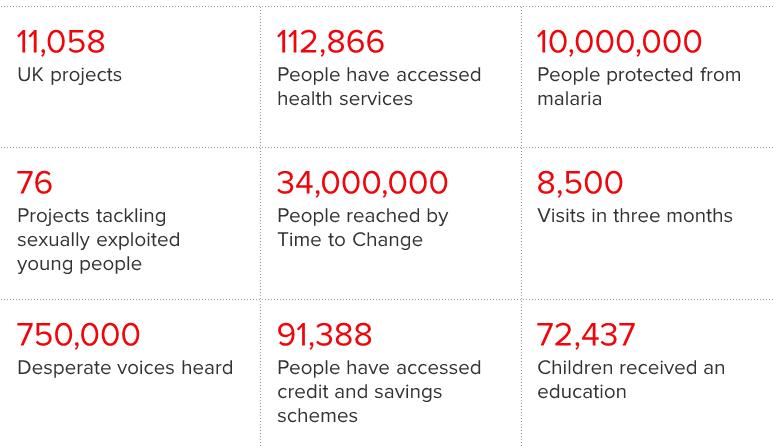
Yes, they report on how much they raise (the input), but they also report on what they achieve (the output) – which after all is the aim of the game. This indicates that they’re more interested in results than process (sometimes donors’ processes takes over, which is a bit of a disaster). For example, this table below is from the results section of their website:

The activity is spread across organisations which directly support individuals and also ones which change government policy, public awareness and system-wide change. An example if the latter is them co-funding a major campaign to change attitudes in the UK to people with mental health problems, ending the discrimination they face.

What else do they do?

They add value to your money. They use their brand, their contacts (eg, getting Sainsbury’s to stock more Fairtrade; getting Alesha Dixon and Chris Moyles et al to climb Mount Kilimanjaro to raise awareness of malaria; and working with the BBC to make programming highlighting abuse of older people) and their influence with other funders.

And lastly, isn’t their fundraising this year just brilliantly innovative? I just love the way they’ve gone out of their way to appeal to people / budgets which might not otherwise be available for charity – win the chance to conduct the BBC Singers (good news for aspiring musicians), get on a comedy flight, win being the cover-face of BA’s inflight magazine (good news for self-publicists).

Donate to Comic Relief: https://www.comicrelief.com/donate 

Why people in charities should dress better–>


Posted in Analysing giving, Promoting giving | 6 Comments

Charitable gifts for the Royal Wedding: analysis of the plan

Prince William &Kate Middleton are asking for donations to a set of charities, rather than wedding gifts. Here’s my analysis of their plan.

Good idea

For sure the couple don’t need any towels from John Lewis. And since charities’ income falls during recessions just as the need for their work rises, some extra cash will certainly help. Hopefully there’ll be a secondary effect too of getting more people (back) into giving to charity.

The charities

Look to have been thoughtfully chosen.

Some reflect the couple’s own backgrounds – the community foundation near Kate’s family home, conservation activity near where they got engaged, and support for service personnel and people who’ve suffered bereavement.

Most striking is that most of them are little-known: in charities, being well-known is almost totally independent* of being any good, so small fantastic charities often struggle to attract the support which their work and professionalism deserves.

Recognise any?

Beat Bullying (does what it says on the tin), Oily Cart (accessible theatre for vulnerable children) and the Association for Children’s Palliative Care are all recommended by independent analysts New Philanthropy Capital. That’s a good sign.

Including the Association for Children’s Palliative Care is particularly interesting. It works across a whole industry, ie, quite a long way from ‘the front line’, and those organisations -whose work has significant reach – often struggle for funds because they’re less visible and emotive.

Any omissions?

“Environment – particularly to build on the growing awareness of the need to find better, more sustainable, models to balance development and the conservation of resources” is one of three areas of focus of the  Foundation of Prince William and Prince Harry (known as “the Princes’ Foundation”), but isn’t represented on the wedding list. That’s odd since its inclusion in the Princes’ Foundation implies that Prince William (rightly) thinks that sustainable development is important.

And none of them are the ones of which Prince William is patron. Very surprising: presumably they’re ‘spreading the love around’ a bit.

 Under the bonnet

The selection of charities. No rationale is given publicly for the choice of those charities. This is a shame because (a)then we don’t know, and (b)they probably have done some due diligence on the charities and there’s an opportunity to show other people how that’s done. There is for example no discussion of the charities’ results – which is a shame. Maybe they’ll report after a year or so on the impact that the wedding gifts make – hope so.

The list has two “community foundations“: what are they? Community foundations support charities within a geographical patch. They typically do a good job of understanding need in their local area, and are effectively a clearing house through which local people can serve that need.

The money will be handled the Princes’ Foundation. Though you can designate charities to receive your gift, in fact it’s all decided by the Foundation’s trustees. This is very normal and good-practice: if we collectively donated a zillion pounds to (say) Oily Cart, that would be enough to blow it up, so the trustees need the right to do a bit of air-traffic control. (This is the same when you send a goat via Oxfam, by the way: you just give money to Oxfam and they do useful things with it. They don’t need the possibility of receiving 60million goats one month.)

So who are the trustees? The Chairman is Lord Janvrin, former Private Secretary to HM Queen and active in charitable activity; Trustees are Sir David Manning (former ambassador), Edward Harley, Jamie Lowther-Pinkerton (the Princes’ Private Secretary), Guy Monson, Baroness (Fiona) Shackleton (the family lawyer).

Charges They’ve persuaded BT and “all UK mobile operators” to drop their fees on SMS donations.

Follow up They’ve committed to thanking everybody who gives, which is great and important. Like I say, I’ll be interested in the impact report in a year or two.

*It’s independent. That doesn’t mean that big ones are universally bad, nor that small ones are good: rather, literally, that there’s a spread of quality amongst both the big and the small – in a way that you don’t get in companies.

Detail on the fund is at http://www.royalweddingcharityfund.org

Posted in Analysing giving, Celebrity giving, Promoting giving | Tagged , , , , , , | 1 Comment

Why don’t we talk about giving?

“I gave some money to a charity the other day, and it was just wonderful. Apparently, my donation helped them to [do something amazing]. I’m so proud and happy.”

Do you ever have conversations like this? I don’t. I realised recently that I’ve literally never had a single social conversation about a personal giving experience, ever, despite knowing loads of people who give, and even having been in charities & philanthropy for over 20 years.

Isn’t that weird?

It’s not like nobody’s got any experience of giving: fully 56% of us give in any given month, and even more volunteer regularly according to the Cabinet Office.

And it’s even weirder when you consider that giving makes us so happy – it’s the best thing known to mankind for cheering us up, with only one exception (which is dancing: which people talk about all the time). Interestingly, clever old ActionAid, in its new donor-recruitment adverts, cite neither the needs (i.e. the problem they address) nor their results (i.e, how good they are at solving it), but focus on the rewarding experience for the donor.

ActionAid3

I’d be really interested to hear your experiences of talking about giving.

  • Do you talk socially about it? How do those conversations start? What reactions do you get – e.g. are people inspired, do they feel you’re using it to signal your wealth?
  • Do people start conversations with you about their giving? How do those conversations start?
  • And if you don’t, what’s holding you back?

It’s important to talk about our giving because we know about the importance of social norms – people do what they see other people doing. [Hence why celebrities get paid to use certain mobile phones in public, and TV producers get paid to ‘place’ products in programmes.]

So if we’re to build a culture of giving – and even to leverage our own giving by inspiring others to follow – we need to talk. On platforms and donor events for sure, but also to our neighbours, friends and colleagues.

Tell me your experiences – we can learn together.

First published by The Funding Network, March 2011

Posted in Promoting giving | 8 Comments